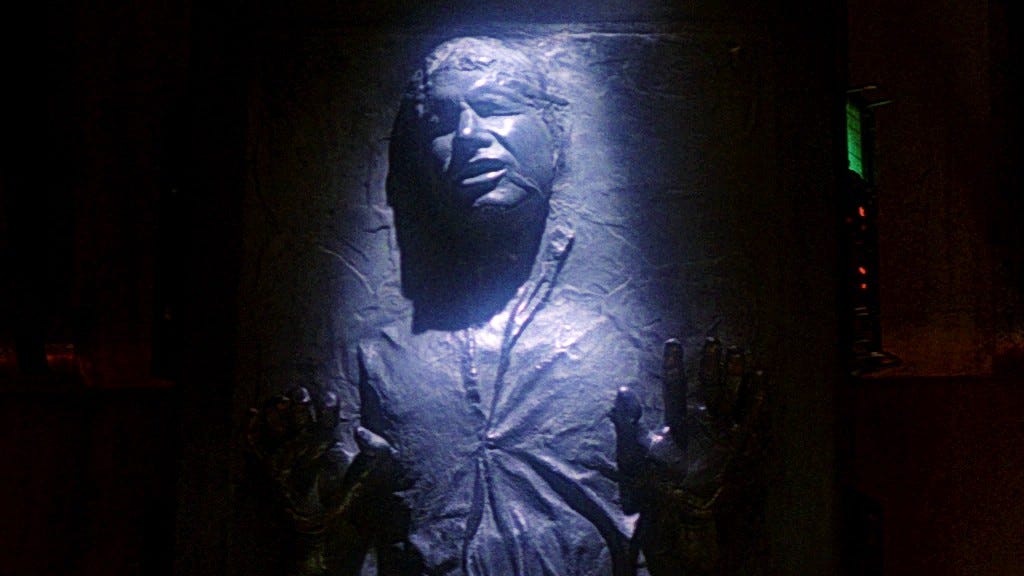
There’s a scene in The Empire Strikes Back where Han Solo is frozen in carbonite.
He’s lowered into a chamber as a living, breathing person and comes out suspended in a solid block.
Frozen exactly as he was in that moment.
Everyone else keeps moving.
The story continues.
Han doesn’t.
At least for a while.
Lately I’ve wondered if estrangement can do something similar to people.
Not physically, obviously.
But in our minds.
When a relationship ends, sometimes our last version of that person becomes the permanent version of that person.
And that’s a strange thing, because almost nothing about being human is permanent.
We change.
All of us.
Sometimes for the better. Sometimes for the worse.
We get older. We experience things. We lose people. We make mistakes. We suffer consequences. We reconsider things we once believed with absolute certainty.
Sometimes we learn lessons far too late.
But we learn them.
I know I’m not the same person I was five years ago.
I’m not even sure I’m the same person I was one year ago.
And I hope that’s true.
Because what would it say about me if I could experience pain, loss, regret and consequences and somehow emerge from all of it completely unchanged?
Yet estrangement creates an unusual problem.
How does someone know you’ve changed if they aren’t there to see it?
If I did something that hurt you and you left my life because of it, that moment may become the last evidence you ever receive about who I am.
Meanwhile, my life continues.
Maybe I recognize what I did.
Maybe I regret it.
Maybe I finally understand something you had been trying to tell me for years.
Maybe I would handle that same situation completely differently today.
But you don’t know any of that.
How could you?
You’re not here.
So somewhere in your mind, I may still be standing in the room where you left me.
Frozen in time.
And I think that’s one of the crueler paradoxes of estrangement.
Sometimes the thing that finally changes a person is losing the relationship.
But losing the relationship also removes the person who would have been able to see the change.
I’ve written before about learning the lesson but never getting another opportunity to take the test.
This feels related.
Because change is easy to claim.
Anyone can say:
I’ve changed.
Those words don’t prove anything.
Real change has to be lived.
It has to survive the next disagreement.
The next misunderstanding.
The next moment when the old version of you would have reacted differently.
That’s the test.
And in estrangement, sometimes there isn’t another test.
So one person continues growing while the other person’s evidence remains exactly where the relationship stopped.
I’m not saying that’s unfair.
I’m not even saying it’s wrong.
Sometimes there are very good reasons not to return to a relationship just to find out whether somebody has changed.
Nobody owes another person access to their life so that person can demonstrate personal growth.
I understand that.
But I can still grieve what it means.
Because the freezing can happen in both directions.
I have to be careful not to freeze my son too.
He has changed.
He has lived his life that I haven’t been part of.
He’s experienced things I know nothing about.
Perhaps he understands our relationship differently today.
Perhaps he doesn’t.
I don’t get to assume that the person I remember is exactly the person he is now simply because that’s the last version of him I knew.
If I want someone to believe that I am capable of changing, I have to extend that same possibility to them.
That’s uncomfortable.
But it’s fair.
Maybe that’s one of the tragedies of estrangement.
Two people can continue changing.
Continue learning.
Continue becoming.
And still carry outdated versions of each other around in their heads.
Eventually Han Solo gets thawed.
The story resumes.
Real life isn’t quite that simple.
There’s no switch someone can flip that instantly reveals everything that happened while you were apart.
If the door ever opens again, we may discover that neither of us is exactly the person the other remembers.
Maybe that’s frightening.
But I also think that’s where hope lives.
Because if people really can change, then the worst moment between two people doesn’t necessarily have to define either of them forever.
I don’t want to be frozen at mine.
And I don’t want to freeze my son at his.
We’re both still becoming.
I just hope someday we get the chance to meet each other again.


Leave a Reply