Baseball is a game built around second chances.
Strike out and, if you’re lucky, you’ll get another at-bat.
Make an error and eventually another ball will be hit your way.
Lose today and there’s another game tomorrow.
Failure matters in baseball.
It just doesn’t have to be final.
Few people understand that better than Rick Ankiel.
In 2000, Ankiel was one of the most promising young pitchers in baseball.
He was 20 years old, went 11–7 for the St. Louis Cardinals, struck out 194 batters and finished second in the National League Rookie of the Year voting.
Then came the playoffs.
In the third inning of his first postseason start, something happened that is still difficult to watch.
Ankiel suddenly couldn’t reliably throw the baseball where he wanted it to go.
He threw five wild pitches in one inning.
This wasn’t a pitcher getting hit hard.
This was a pitcher seemingly losing the ability to do the most fundamental part of his job.
Throw the ball to the catcher.
And it didn’t simply go away.
The control problems continued. There were trips to the minor leagues, attempts to fix it, injuries and a return to pitching.
Eventually Ankiel decided he couldn’t do it anymore.
For most baseball players, that’s where the story ends.
But Rick Ankiel got another chance.
Actually, that’s not quite right.
He didn’t get another chance to pretend the first chance hadn’t happened.
Nobody erased those wild pitches.
Nobody pretended he could still be the pitcher everyone once expected him to become.
His second chance looked completely different.
He became an outfielder.
Think about how ridiculous that is for a moment.
A major-league pitcher essentially started his professional baseball career over.
He went back to the minor leagues.
He learned another position.
He worked his way back.
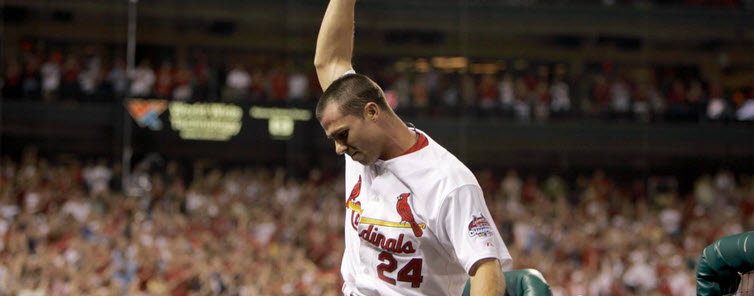
And on August 9, 2007—nearly seven years after that disastrous postseason inning—Rick Ankiel returned to the major leagues as an outfielder.
In the seventh inning, he hit a three-run home run.
The crowd gave him a standing ovation and brought him back out of the dugout for a curtain call.
The following season he hit 25 home runs for the Cardinals.
Rick Ankiel went on to spend seven seasons in the majors as an outfielder.
He wasn’t the pitcher everyone thought he was going to become.
He became something else.
And someone gave him the opportunity to show them.
We love stories like that.
We cheer for the comeback.
We admire the person who fails and tries again.
We tell our children that mistakes are how they learn.
We tell people to get back on the horse.
We celebrate redemption stories in sports, business, movies and books.
My faith is built around grace, forgiveness, redemption and restoration.
We seem to believe deeply in second chances.
Until we’re the person being asked to give one.
Then things become considerably more complicated.
Because a second chance requires something from both people.
For the person asking for it, it requires humility.
You don’t get to pretend the first chance went perfectly.
Rick Ankiel couldn’t walk back onto the mound and insist those wild pitches never happened.
Something had gone wrong.
It had to be acknowledged.
Things had to change.
But a second chance also requires something from the person giving it.
It requires the willingness to consider a possibility:
Maybe what happened isn’t all this person will ever be.
That’s harder.
Especially when you’re the one who was hurt.
I’ve thought about that a lot in estrangement.
There are things I wish I had done differently.
There are things I’ve learned.
There are things I understand now that I didn’t understand then.
There are probably things I still don’t understand.
And I don’t believe growth somehow creates an obligation for someone else to let me back into their life.
Nobody owes me a second chance.
That’s important.
An apology isn’t a contract.
Regret doesn’t create entitlement.
Change doesn’t require someone else to trust that the change is real.
But there’s another truth sitting beside that one.
It’s remarkable how many of the stories we admire would never have been written if nobody had been willing to give one.
Maybe that’s what I find so moving about Rick Ankiel’s story.
His second chance wasn’t about returning everything to the way it had been.
It couldn’t be.
That version of the story was over.
His second chance was simply the opportunity to demonstrate that the ending of one story didn’t have to be the ending of his story.
I think relationships can be like that too.
Maybe reconciliation doesn’t mean going back.
Maybe it shouldn’t.
Maybe whatever existed before wasn’t working.
Maybe too much happened.
Maybe too much changed.
Maybe both people changed.
A second chance doesn’t have to mean:
Let’s pretend none of this happened.
It might simply mean:
Let’s see what’s possible now.
There’s something else baseball understands unusually well.
A player can strike out badly in the third inning and nobody assumes he should be prohibited from batting in the sixth.
Why?
Because we understand something instinctively when we’re watching a game:
The next at-bat hasn’t happened yet.
We don’t know what he’ll do.
He might strike out again.
He might hit a home run.
Giving him another opportunity doesn’t guarantee a different result.
It simply allows for one.
Maybe that’s all a second chance really is.
Not forgiveness without accountability.
Not forgetting.
Not pretending there wasn’t pain.
Not a guarantee that things will work this time.
Just allowing for the possibility that the next at-bat could be different from the last one.
I don’t know whether I’ll ever get another at-bat.
That’s one of the hardest parts of estrangement.
I don’t know whether I’ll ever have the opportunity to demonstrate what I’ve learned.
And if that opportunity ever comes, I certainly don’t expect to step back onto the field as though nothing happened.
Too much has.
Maybe that’s okay.
Rick Ankiel didn’t become the pitcher everyone expected him to be.
He became something else.
And there is something incredibly hopeful about that.
Because sometimes a second chance isn’t an opportunity to restore the person you used to be.
Sometimes it’s an opportunity for someone you love to meet the person you’ve become.
And maybe that’s why we love second-chance stories so much.
They remind us of something we desperately want to believe about ourselves and about the people we love:
The last time doesn’t have to be the last word.


Leave a Reply