Our pastor did something yesterday that I haven’t been able to stop thinking about.
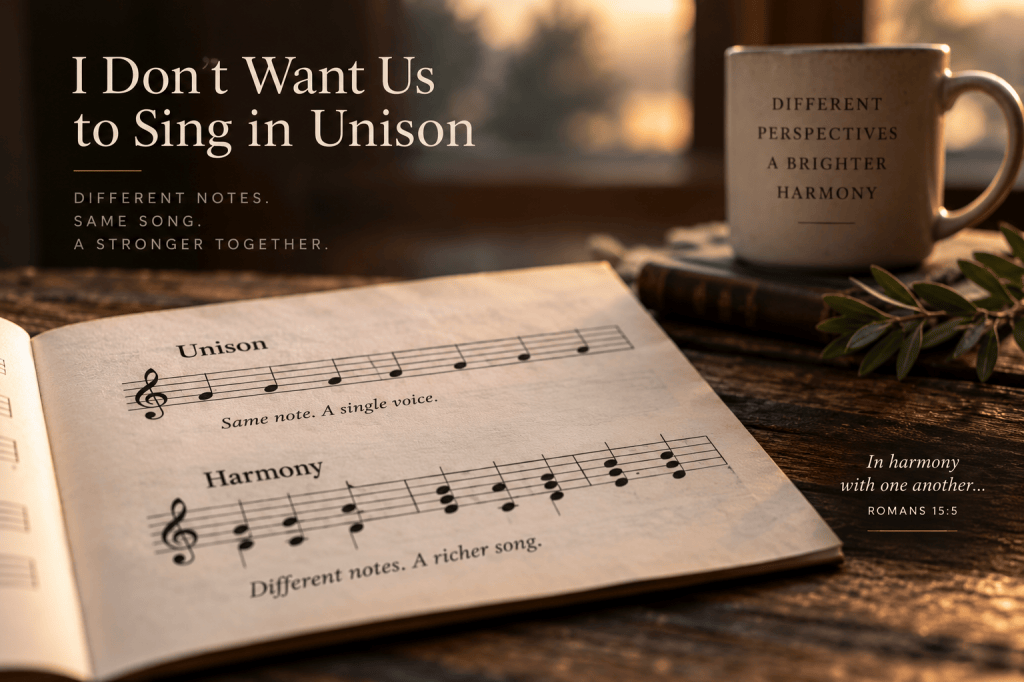
He had people sing in unison.
Same notes.
Same melody.
Same time.
It sounded good.
Then they sang in harmony.
Different notes.
Same song.
And the difference was remarkable.
The harmony was richer. Fuller. More beautiful.
But what struck me wasn’t simply how it sounded.
It was what harmony required.
Difference.
You cannot sing harmony while everyone sings the same note.
That’s unison.
Harmony only becomes possible when different notes exist together.
I’ve thought about that a lot since then.
Especially because we use the word harmony to describe relationships.
We want harmonious marriages.
Harmonious families.
Harmonious communities.
We pray to live in harmony with one another.
But I wonder if sometimes what we actually mean is:
I want you to sing my note.
Agree with me.
See what I see.
Remember what I remember.
Reach the conclusion I reached.
Believe what I believe.
Then we’ll have harmony.
Except that’s not harmony.
That’s unison.
Paul writes about this in Romans 15.
He talks about the strong and the weak.
About bearing with one another.
About not simply pleasing ourselves.
About building up our neighbor.
And then he prays:
“May the God of endurance and encouragement grant you to live in such harmony with one another…”
I find the word endurance particularly interesting.
Apparently living in harmony with people requires some.
That makes sense.
Differences are easy to celebrate until they actually inconvenience us.
It’s easy to say we value different perspectives until someone’s perspective is about us.
It’s easy to say everyone is entitled to an opinion until their opinion feels unfair.
It’s easy to talk about grace until we’re asked to extend it to someone whose version of the story conflicts with ours.
That’s when harmony gets difficult.
Christians sometimes distinguish between essentials and non-essentials.
There are things central to the faith.
And then there are countless things about which sincere people can disagree.
The goal isn’t to eliminate every disagreement.
It isn’t to force every person into intellectual unison.
It’s to remain united even when we’re singing different notes.
That sounds beautiful in church.
It’s considerably harder in a family.
Estrangement has made me think about how desperately we sometimes want unison.
I have my memories.
Someone else has theirs.
I have my intentions.
Someone else experienced their impact.
I have things I believe I did right.
I have things I know I did wrong.
There are things I regret.
There are also accusations I may genuinely see differently.
And perhaps one of the greatest temptations in a broken relationship is believing reconciliation can happen only after somebody changes notes.
You need to admit this.
You need to understand that.
You need to acknowledge what really happened.
You need to see why I did what I did.
Eventually the relationship becomes a contest over whose note everyone will sing.
And I’ve started wondering:
What if reconciliation doesn’t require unison?
What if two people could say:
That’s not how I remember it.
And remain in the room?
What if one could say:
That hurt me.
And the other could respond:
I didn’t intend to hurt you.
And neither statement had to erase the other?
What if:
I understand why you feel that way
didn’t have to mean:
I agree with everything you believe about me.
What if:
I remember it differently
didn’t automatically mean:
Your pain isn’t real.
Maybe those are different notes.
And maybe they can exist in the same song.
That doesn’t mean every note works.
Harmony isn’t random noise.
A choir isn’t beautiful because everyone sings whatever they want.
They’re still singing the same song.
They’re listening to one another.
They’re adjusting.
They’re making room.
Sometimes one voice gets quieter so another can be heard.
Sometimes one holds a note while another moves.
Nobody gets to ignore everyone else and call the result harmony.
That’s chaos.
Maybe relationships work similarly.
Harmony doesn’t require agreement on everything.
But it does require something from everyone.
Listening.
Humility.
Restraint.
Grace.
Endurance.
And perhaps most importantly:
The willingness to let another person’s note exist without experiencing it as a threat to your own.
That’s hard.
Especially when the disagreement involves pain.
There are things we can shrug our shoulders about.
Favorite foods.
Politics at the dinner table, if we’re lucky.
How to load the dishwasher.
There are other disagreements that reach much deeper.
Who hurt whom.
Who failed whom.
Who tried.
Who didn’t.
What happened ten years ago.
What should have happened instead.
Those notes aren’t easy to hear.
Sometimes they’re painful.
And there are circumstances where what happened was so destructive that distance really is necessary.
Harmony should never become an excuse for tolerating abuse or pretending serious harm doesn’t matter.
But I wonder whether we’ve also become too quick to assume that relational peace requires agreement.
Maybe some relationships don’t need a verdict.
Maybe they need harmony.
There is another part of that passage I keep coming back to.
Paul doesn’t say:
Therefore convince one another.
He doesn’t say:
Therefore correct one another until everyone agrees.
He says:
“Therefore welcome one another as Christ has welcomed you.”
Welcome one another.
There’s something almost radical about that.
Because welcoming someone doesn’t necessarily mean agreeing with them.
It means making room for them.
And perhaps that’s what harmony really is.
Making room.
I think about what reconciliation would look like in my own life.
Of course there are things I would love to hear.
There are things I would love the opportunity to say.
There are questions I’d like answered.
There are things I’d like understood.
And if I’m being fair, there are probably things someone else desperately wants me to understand too.
Maybe we’d agree about some of them.
Maybe we wouldn’t.
For a long time, I think I’ve imagined reconciliation eventually producing some shared understanding of what happened.
A final version of the story.
One melody.
One set of notes.
Unison.
I’m less certain that’s necessary anymore.
Maybe reconciliation could sound different.
Maybe it could be two people remembering some things differently and loving each other anyway.
Two people disagreeing without disappearing.
Two people occasionally hitting a bad note, stopping, listening, adjusting, and beginning again.
Not unison.
Harmony.
Maybe that’s what we’ve forgotten about harmony.
Harmony isn’t beautiful despite the differences.
Harmony is beautiful because of them.
The lower note doesn’t have to become the higher one.
The higher note doesn’t have to prove the lower one wrong.
They remain different.
But they listen to each other.
They adjust to each other.
And somehow, together, they create something neither could create alone.
I don’t need everyone I love to sing my note.
And perhaps I need to stop believing that love requires me to sing theirs.
Maybe we just need enough humility to listen for the song we’re both still part of.
Because the goal was never for all of us to sound the same.
The goal was to learn how to sound beautiful together.
 Held Hostage By Hope
Leave a comment