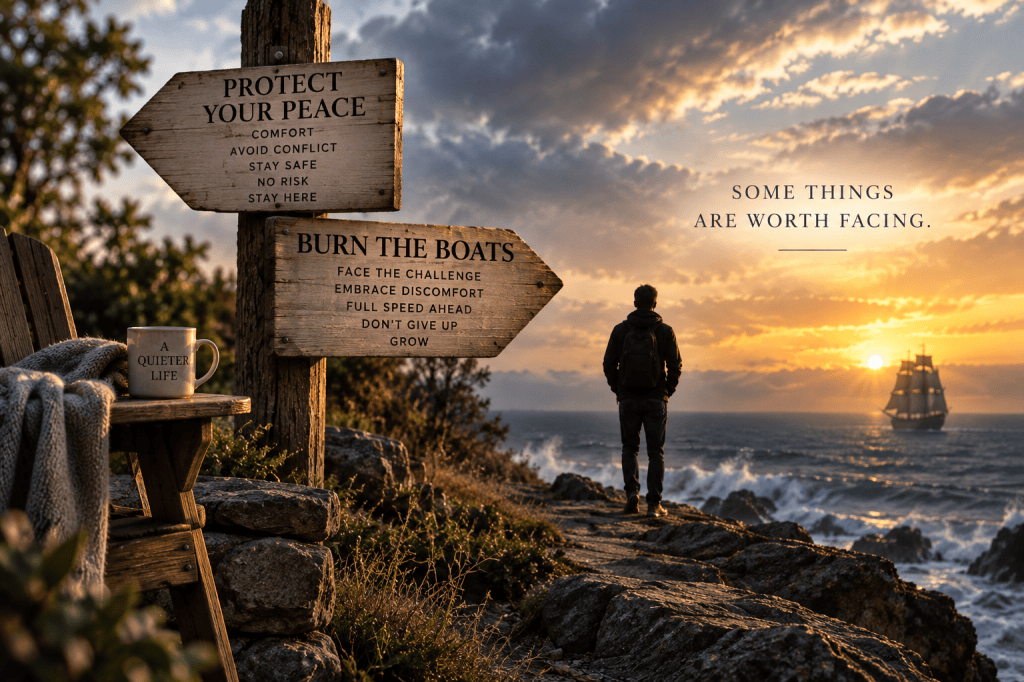
“Protect your peace.”
I don’t remember hearing that phrase when I was younger.
Now I see it everywhere.
Protect your peace.
Remove yourself from people who disturb it.
Avoid situations that threaten it.
Set boundaries around it.
Don’t engage with anything that costs you your peace.
And, in theory, I understand the idea.
There are people and situations that can consume us. There are relationships that become destructive. There are arguments that accomplish nothing. There are circumstances where walking away isn’t cowardice.
It’s wisdom.
Sometimes peace really does need protecting.
But lately I’ve found myself wondering about the other side of that advice.
What if protecting our peace also protects us from growth?
Almost nothing that has caused me to grow as a person has been particularly peaceful.
Growth usually begins with discomfort.
Someone tells me something I don’t want to hear.
I fail.
I embarrass myself.
I’m afraid.
Someone challenges what I believe.
A relationship becomes difficult.
I discover something about myself I’d rather not know.
I have to admit I was wrong.
None of those experiences protect my peace.
They disturb the hell out of it.
And that’s often the point.
Muscles don’t grow because we protect them from resistance.
They grow because we expose them to it.
Ideas aren’t strengthened by never being challenged.
Character isn’t developed by never being tested.
Courage isn’t developed by avoiding fear.
And relationships don’t become stronger because two people successfully avoid every difficult conversation.
Growth requires resistance.
Maybe that’s why I find some of our older expressions about courage so fascinating.
They sound almost absurd compared with “protect your peace.”
Burn the boats.
The expression has been attached to different historical stories, but the idea is simple: eliminate the possibility of retreat.
There is no going back.
Whatever is in front of you, you face it.
Then there’s:
Don’t give up the ship.
And:
Damn the torpedoes. Full speed ahead.
These aren’t peaceful expressions.
They’re practically declarations of war against peace.
There’s danger ahead.
There’s uncertainty ahead.
There may be pain ahead.
Proceed anyway.
Obviously, I’m not suggesting we conduct our relationships like naval battles.
Although some family gatherings might qualify.
But there is something in those old expressions that I worry we’re losing.
The assumption that some things are worth enduring discomfort for.
Courage requires conflict of some kind.
Not necessarily conflict with another person.
Sometimes the conflict is entirely within ourselves.
Fear says don’t go.
Courage says go.
Anxiety says avoid it.
Courage says face it.
Pride says defend yourself.
Courage sometimes says listen.
Shame says hide.
Courage says be seen.
Comfort says stay where you are.
Growth says move.
That’s the paradox of courage.
We tend to think courageous people don’t experience the things we’re trying so hard to avoid.
Fear.
Anxiety.
Uncertainty.
Discomfort.
But without those things, courage has nothing to do.
You cannot be courageous in the absence of something you’d rather not face.
Imagine applying “protect your peace” as an absolute principle to the people we admire most.
What would our country look like if generations before us had decided discomfort was evidence that they should disengage?
What if people facing injustice had protected their peace instead of disturbing everyone else’s?
What if soldiers had protected their peace?
What if explorers had protected their peace?
What if abolitionists had protected their peace?
What if civil-rights marchers had decided confrontation was unhealthy?
What if every person who saw something wrong simply decided:
This situation is costing me my peace.
Of course, those are enormous examples.
Most of us aren’t being asked to storm a beach or change the course of history.
But perhaps that’s precisely why the smaller examples matter.
Courage is usually practiced long before anyone needs us to be heroic.
Maybe courage begins in an uncomfortable conversation.
Maybe it means sitting across from someone who remembers something differently than you do.
Maybe it means hearing criticism without immediately constructing a defense.
Maybe it means saying something that needs to be said even though your hands are shaking.
Maybe it means apologizing.
Maybe it means forgiving.
Maybe it means admitting:
I don’t know.
Maybe it means remaining in the room for five minutes longer than you want to.
None of those things necessarily protect your peace.
But they might protect something else.
A friendship.
A marriage.
A family.
Or perhaps simply the possibility that you might leave the conversation a slightly different person than the one who entered it.
Estrangement makes this question particularly uncomfortable for me.
Because “protect your peace” fits remarkably well within the language surrounding estrangement.
Boundaries.
No contact.
Toxicity.
Protecting your mental health.
Removing people who disturb your peace.
And I want to be very careful here.
Sometimes those things are necessary.
There are relationships where distance is the healthy choice. There are circumstances I know nothing about. Nobody reading this should interpret my words as an argument that they are required to remain in a relationship that is harming them.
But I also don’t think every uncomfortable relationship is a harmful relationship.
I don’t think every difficult conversation is a toxic one.
I don’t think anxiety automatically means something should be avoided.
And I don’t think peace is always evidence that we’ve made the right decision.
Sometimes peace is what we feel because we’ve successfully removed everything that challenges us.
That’s a very different kind of peace.
I can protect my peace by avoiding the person who tells me I’m wrong.
I can protect my peace by refusing the difficult conversation.
I can protect my peace by surrounding myself only with people who agree with my version of events.
I can protect my peace by never asking whether I contributed to the problem.
I can protect my peace by deciding that anyone who makes me uncomfortable doesn’t belong in my life.
That would certainly be peaceful.
But would I grow?
I’m not sure.
Maybe we’ve confused two very different things:
Peace and comfort.
Peace can exist in the middle of difficulty.
Comfort usually requires the difficulty to disappear.
And perhaps real peace isn’t something so fragile that it can only survive if nothing disturbs it.
Maybe real peace is something we develop precisely because life keeps disturbing it.
The person who has never faced conflict isn’t necessarily peaceful.
They may simply be untested.
I keep coming back to those ships.
Don’t give up the ship.
Damn the torpedoes.
Burn the boats.
They’re extreme phrases from different times and circumstances, but underneath them is the same stubborn idea:
There are things worth moving toward even when moving toward them costs us something.
Maybe that’s courage.
Not the absence of fear.
Not the absence of anxiety.
Not the preservation of comfort.
But deciding that something on the other side of our discomfort matters enough to move toward anyway.
So yes.
Protect your peace.
There are times when that’s exactly what you should do.
But I think I’ll add something to it.
Don’t protect your peace so carefully that you protect yourself from becoming someone better.
Some conversations should disturb us.
Some criticism should bother us.
Some relationships should challenge us.
Some fears should be confronted.
Some boats should be burned.
Some ships shouldn’t be surrendered.
And sometimes there really are torpedoes in the water.
Courage doesn’t pretend they aren’t there.
Courage says full speed ahead.


Leave a Reply