Picture, if you will, a courtroom.
You are standing before the judge.
You know you’ve been convicted.
You know this because the sentence has already begun.
Someone you love has disappeared from your life.
Phone calls go unanswered.
Messages receive no response.
Birthdays pass.
Holidays pass.
Years may pass.
So there must have been a crime.
There’s just one problem.
You’re not entirely sure what it was.
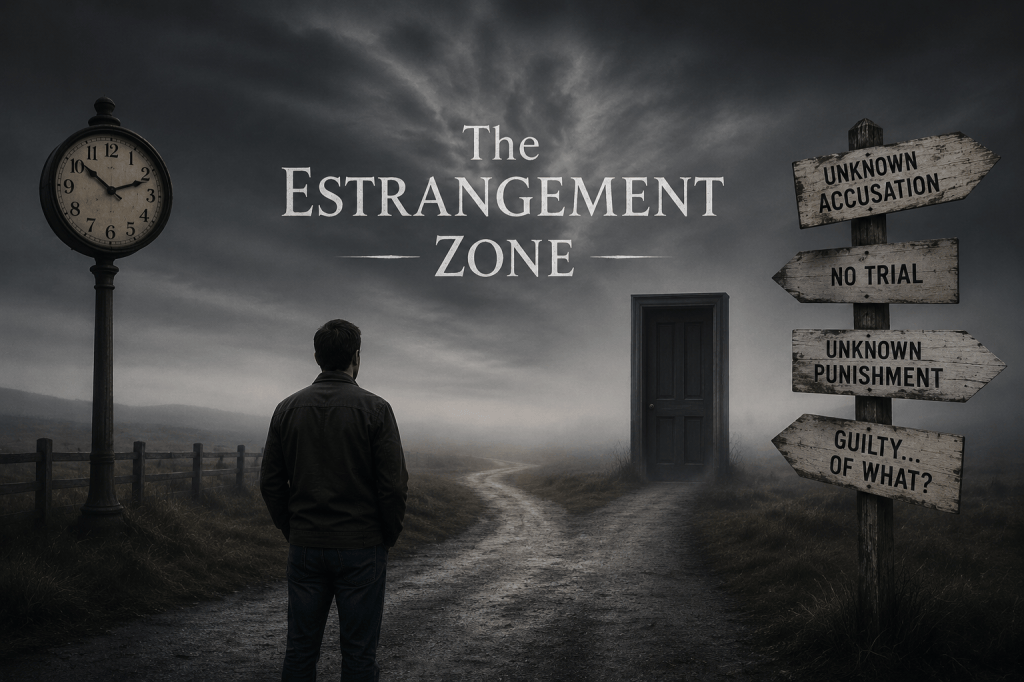
Welcome to the Estrangement Zone.
The rules here are a little different.
You don’t necessarily get an indictment.
There may be no list of charges.
There is no discovery process where the evidence against you is laid out on a table.
There are no witnesses to cross-examine.
There is no jury of your peers.
And there may never be a trial where you get to stand up and say:
This is what happened from where I was standing.
Instead, you discover the verdict by experiencing the sentence.
Guilty.
Of what, exactly?
That’s where things get complicated.
Maybe you’ve been told some things.
Maybe you’ve even been told many things.
Maybe some of them are legitimate.
Maybe some make perfect sense when you force yourself to look at them without immediately becoming defensive.
Maybe others bear almost no resemblance to the events as you remember them.
And maybe the most maddening category is everything in between.
The accusations that are just specific enough to hurt but not specific enough to understand.
You weren’t there for me.
You never supported me.
You made everything about you.
You don’t respect me.
You’ve always been this way.
Those statements may represent very real pain.
But when you’re on the receiving end, they can leave you desperately searching through decades of memories looking for the crime scene.
When?
What did I say?
What should I have done instead?
What don’t I understand?
And sometimes asking those questions becomes another charge.
That’s one of the strangest features of the Estrangement Zone.
Almost anything you do in response to the verdict can become additional evidence supporting it.
You reach out.
You don’t respect boundaries.
You don’t reach out.
See? You never really cared.
You explain your side.
You’re defensive and incapable of taking accountability.
You don’t explain your side.
You refuse to acknowledge what you’ve done.
You apologize.
You’re only apologizing because there are consequences.
You don’t apologize for something you don’t understand.
You aren’t sorry.
You ask what you did.
The fact that you have to ask proves you’ll never understand.
You say you understand.
Then you’re admitting you knew exactly what you were doing.
You tell family members you’re hurting.
You’re recruiting people to your side.
You don’t talk about it.
You’re hiding what happened.
You keep living your life.
Clearly losing the relationship didn’t affect you very much.
You fall apart.
This emotional reaction is exactly why the boundary was necessary.
Round and round it goes.
Every road somehow leads back to the same destination.
Guilty.
There’s a name for an argument that can’t be disproven.
It’s unfalsifiable.
Any evidence against the conclusion is simply absorbed into the conclusion itself.
And that’s what estrangement can sometimes feel like.
Not disagreement.
Not even punishment.
Something stranger.
A world in which the verdict explains the evidence rather than the evidence determining the verdict.
Once you’ve been assigned a role in the story, everything you do can be interpreted through that role.
If you’re controlling, your attempts to reconcile are controlling.
If you’re selfish, your grief is selfish.
If you’re manipulative, your apology is manipulation.
If you’re emotionally unavailable, giving space proves your emotional unavailability.
The interpretation comes first.
Your behavior simply fills in the blanks.
Welcome back to the Estrangement Zone.
There’s another unusual feature of this courtroom.
Nobody tells you how long the sentence is.
Thirty days?
Six months?
Five years?
Life?
There is no release date.
No parole hearing.
No judge saying:
You’ve served your time.
You don’t even know whether good behavior counts.
So you wait.
At first, maybe you assume this is temporary.
Everyone needs some space.
Things cool down.
People reflect.
Eventually we’ll talk.
Then a birthday passes.
Then Christmas.
Then another birthday.
At some point you realize something terrifying.
This may not be a timeout.
This may simply be your life now.
And still, you don’t know the terms of release.
What would reconciliation require?
An apology?
Which one?
An acknowledgment?
Of what, specifically?
Changed behavior?
Which behavior?
How would you demonstrate that change when you’re no longer permitted to have a relationship in which that behavior could occur?
That’s another strange rule here.
You may be expected to change while being denied the opportunity to demonstrate change.
You are told, directly or indirectly, that the person you were was unacceptable.
Fair enough.
Maybe you needed to change.
Maybe you needed to learn.
Maybe losing the relationship forced you to see things you should have seen years ago.
But eventually you find yourself asking:
How does anyone discover whether I’ve changed if they never interact with me again?
There’s no next test.
Only the grade from the last one.
I know how dangerous this argument can become.
It’s easy for an estranged parent to construct an imaginary courtroom where we’re the innocent defendant and our child is the unreasonable judge.
That’s not what I’m trying to do.
I don’t believe I’m innocent of every charge.
I’m certain I’ve made mistakes as a father.
Some I recognize.
Some I’ve only recognized because estrangement forced me to look at them.
And there are probably others I still don’t see.
My son has his own experience of me.
He doesn’t need my permission for that experience to be real.
If he was hurt, then he was hurt.
I don’t get to cross-examine him out of his pain.
But there’s a difference between saying:
Your experience is real.
and saying:
Your interpretation is the only admissible version of our history.
That’s where I struggle.
Two people can experience the same relationship and walk away carrying remarkably different stories about what happened inside it.
I wish there were a place where both stories could exist.
Not a courtroom, actually.
A conversation.
Maybe that’s what I’ve wanted all along.
Not acquittal.
Not a jury declaring me innocent.
Not my son standing before the world and announcing that his father was right.
Just the opportunity to understand the charges.
To say:
I remember that differently.
Or:
I didn’t realize that hurt you.
Or:
You’re right. I screwed that up.
Or even:
I still don’t understand. Help me.
And then to hear his response.
And for him to hear mine.
Not because one of us gets to win.
Because relationships aren’t courtrooms.
Or at least they shouldn’t be.
Perhaps that’s the cruelest illusion created by estrangement.
We start thinking in terms of guilt and innocence.
Victim and offender.
Right and wrong.
Sentence and punishment.
But families aren’t legal systems.
There isn’t a neutral judge somewhere with access to the complete transcript.
There are just people.
Hurt people.
Angry people.
Confused people.
People remembering the same Tuesday differently.
People protecting themselves.
People making mistakes while reacting to other people’s mistakes.
People who love each other and sometimes hurt each other anyway.
And occasionally, people who become so convinced of the role everyone occupies that they can no longer see the person playing it.
I don’t need a trial.
I don’t need witnesses.
I don’t need a jury of my peers.
And I certainly don’t need a verdict of not guilty.
What I want is much simpler.
I want to know what happened.
I want to understand what I don’t understand.
I want the opportunity to own what is mine without being required to own what isn’t.
I want my son to be able to tell his story.
And I want there to be enough room left in that story for me to tell mine.
Most of all, I want the possibility that neither of us has to remain forever frozen in the role we occupied when everything fell apart.
Because that’s the problem with verdicts.
They’re designed to end arguments.
Relationships require something much harder.
The willingness to keep talking.
Until then, I suppose I’ll remain here.
Somewhere between guilty and innocent.
Between reaching out and giving space.
Between accepting the sentence and still hoping someday someone tells me when it ends.
Somewhere in…
The Estrangement Zone.


Leave a Reply